

Stop Setting Your Dog Up to Fail | Thresholds Explained | Pet Logic Perth
Stop Setting Your Dog Up to Fail — Understanding Thresholds in Dog Behaviour
Your dog isn't getting better with more exposure. They're getting worse. Here's why, and the evidence-based path to real behaviour change.
One of the most common patterns I see in my consulting room is a well-meaning owner who has accidentally made their dog's behaviour worse. They were told to "socialise" their anxious dog. So they took them to the busy dog park, or walked them through a crowded café strip, hoping the dog would just get used to it. Instead, the dog got worse — more reactive, more anxious, harder to manage. This is not a training failure. It is a predictable outcome of pushing a dog past what they can handle. And it all comes back to thresholds.
What Thresholds Actually Mean
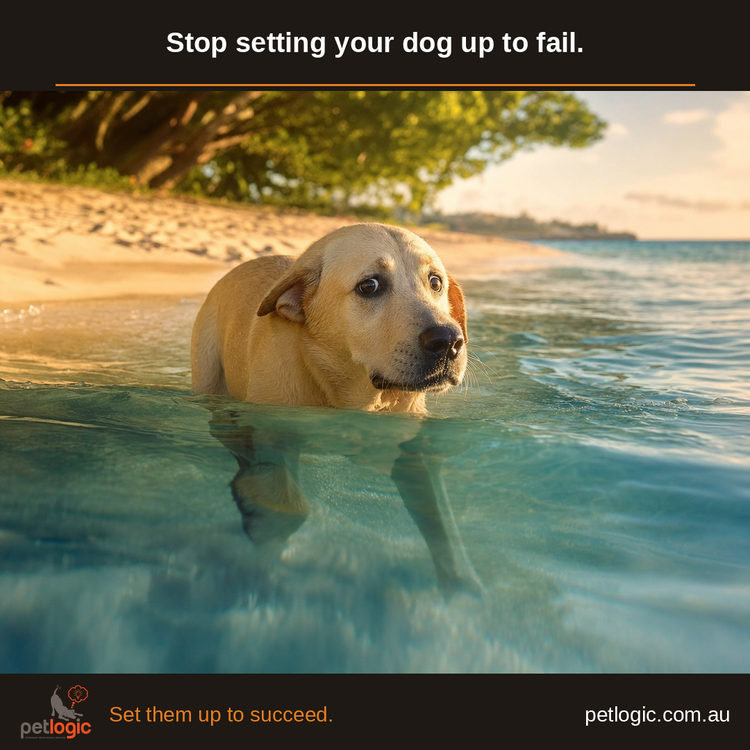
Think of your dog's stress like rising water at the beach. There are three distinct zones, and your dog's ability to learn — or not learn — depends entirely on which zone they're in.
Under threshold is the beach. Your dog is calm, relaxed, their brain is in learning mode. They notice the trigger — the other dog in the distance, the sound of the vacuum — but they're alert and can still disengage. They can take treats. They can respond to their name. They can follow you. The water isn't touching them yet.
Approaching threshold is where the water touches their ankles. Your dog notices the trigger more acutely. They're paying attention but they can still respond to you. Their heart rate is rising. If you increase the intensity now, they'll go under. But if you keep the distance or reduce the trigger, you can hold them here safely while they build confidence.
Over threshold is when the water is over their head. Your dog is drowning. They're barking, lunging, trying to escape, or shutting down completely. Their brain has switched to survival mode. In this state, no learning happens. Your dog is not "getting used to it." They are experiencing panic. And every moment they stay there, the association gets stronger: other dogs = danger, traffic = terror, crowds = threat.
This is the critical misunderstanding that sets so many dogs up to fail. When a dog is over threshold, their brain is flooded with cortisol and adrenaline. The part of their brain that learns and processes information goes offline. They are physically incapable of making the association you're hoping they'll make. The only thing they're learning is that the situation is dangerous and they should panic harder next time.
Why "Just Expose Them" Makes Things Worse
This is flooding, and I see the consequences of it almost every week in my consulting room. Here's the pattern: Your dog is reactive to other dogs. A well-meaning friend or trainer suggests you take them to the dog park so they'll "learn other dogs are safe." Logical. Wrong.
Your reactive dog arrives at the dog park. They are immediately overwhelmed — over threshold from the moment you step through the gate. Now two things happen, and both make the problem worse.
Option one: Your dog reacts — lunging, barking, snapping at the other dogs. The other dogs move away. And what has your dog just learned? That aggression works. That barking makes threats go away. This is called reinforcement. The behaviour gets stronger, not weaker. You just taught your dog that reactivity is a successful strategy.
Option two: Your dog shuts down. They go still, stop responding, freeze. You think they're getting "calm" or "getting used to it." They're not. They've given up trying to escape. This is learned helplessness — a psychological injury where the dog stops trying because nothing they do makes the fear stop. The moment you leave the park, they might fall apart. They might become hyper-vigilant. They've learned that you cannot protect them.
Either way, something important is eroded: your dog's trust in you as their handler. You brought them into a situation they couldn't handle, and you didn't protect them from it. This trust is hard to rebuild.
Real Behaviour Change Starts in the Shallows
If you were terrified of deep water, the solution isn't to throw you off a boat. The solution is to start at the ankle, build your confidence, and let you choose when to go deeper. Dogs need the same respect.
Start on dry land. This is where most people skip the most crucial step. Before you ever expose your dog to the trigger, build foundational skills in an environment with zero triggers. Your living room. Your backyard. Teach focus. Teach disengagement — the ability to look away from distractions and back at you. Teach a reliable sit, a solid recall, and a "check-in" where your dog voluntarily looks at you for reassurance.
These skills are not just obedience. They are your dog's toolkit for coping. When your dog knows they can look to you and you'll handle it, they're far more likely to stay calm when the trigger appears.
Move to the shoreline. Once those skills are solid — really solid, not just occasionally responsive — introduce the trigger at a distance where your dog notices it but stays under threshold and can still respond to you. You're at the ankle now. The dog notices the other dog in the distance, but they're calm enough to take a treat, to respond to their name, to re-engage with you.
Work at that distance until it's boring. I mean truly boring — your dog sees the trigger and barely glances. This takes time. Weeks, sometimes months. That's normal. You're rebuilding the dog's emotional response from the ground up.
Reduce the distance incrementally. Only when your dog is genuinely comfortable at one distance do you move slightly closer. Not dramatically closer. A few metres. Maybe the next week, a few metres closer again. This is called systematic desensitisation, and it works because your dog is actually learning — not just surviving.
Think of it this way: if you were terrified of deep water, the solution is not to throw you off a boat. The solution is to start at the ankle, build your confidence, and let you choose when to go deeper. Dogs need the same respect.
How to Know If Your Dog Is Over Threshold
Learn these signs. They tell you when to stop and step back.
What Real Support Looks Like
A veterinary behaviour assessment does one crucial thing: it identifies exactly what's driving your dog's reactions. Is it fear? Anxiety? Pain? A medical condition? A learned behaviour? A combination? Most behaviour problems are not one-dimensional, and treating them as if they are is why so many owners end up frustrated.
From that clarity, we build a structured plan that works at your dog's pace. With medication support if appropriate — because sometimes a dog's anxiety is so high they can't learn, and medication helps bring them into a space where learning can happen. The goal is not to suppress the behaviour. The goal is to change how your dog feels about the trigger. When the feeling changes, the behaviour follows.
Frequently Asked Questions
Let's Start in the Shallows
A veterinary behaviour assessment gives you the clear plan and specific toolkit your dog needs. No more guessing. No more flooding. Just structured, evidence-based progress.
Book an Assessment